
Most real estate agents know they need a website. Far fewer understand how to make that website work for them around the clock. Search engine optimization is the difference between a site that sits quietly online and one that generates leads while you sleep. However, real estate SEO is not the same as general SEO. It has its own rules, its own rhythms, and its own rewards.
The good news is that most of your competitors are still ignoring the fundamentals. That gap is your opportunity. These five secrets have helped agents transform their online presence from invisible to indispensable. Start applying them today, and the results will follow.
Secret 1: Hyperlocal Keywords Beat Generic Ones Every Time
Most agents make the same mistake early on. They target broad phrases like “homes for sale” or “real estate agent” and wonder why their site never ranks. The truth is simple: those phrases are dominated by Zillow, Realtor.com, and Redfin, and you cannot outrank them with a standard agency website without partnering with an experienced link building service provider in real estate to build true domain authority.
What you can do is go narrower and go deeper. Hyperlocal keywords are phrases that target a specific neighborhood, school district, street, or zip code. These phrases have far less competition and far higher conversion rates. Someone searching “3-bedroom homes near Riverside Elementary in Naperville” is much closer to deciding than someone typing “homes for sale Illinois.”
Think about how your buyers actually search. They search by commute routes, school ratings, walkability, and community names. Your content should mirror that language.
| Keyword Type | Example | Competition Level | Conversion Potential |
| Generic | Homes for sale in Texas | Very High | Low |
| City-Level | Homes for sale in Austin TX | High | Medium |
| Neighborhood | Bungalows for sale in East Austin | Medium | High |
| Hyperlocal | 4-bed homes near Barton Hills Elementary Austin | Low | Very High |
Additionally, hyperlocal keywords are easier to rank for because most national portals ignore them. A well-written neighborhood page on your site can reach the top of search results within weeks. That is not possible with broader terms.
Start by listing every neighborhood, subdivision, school district, and zip code you serve. Then build a dedicated page for each one. Fill those pages with genuinely useful information about the area — not just listings, but schools, parks, restaurants, commute times, and community character. Google rewards pages that answer real questions with real detail.
Secret 2: Google Business Profile Is a Lead Machine Most Agents Ignore
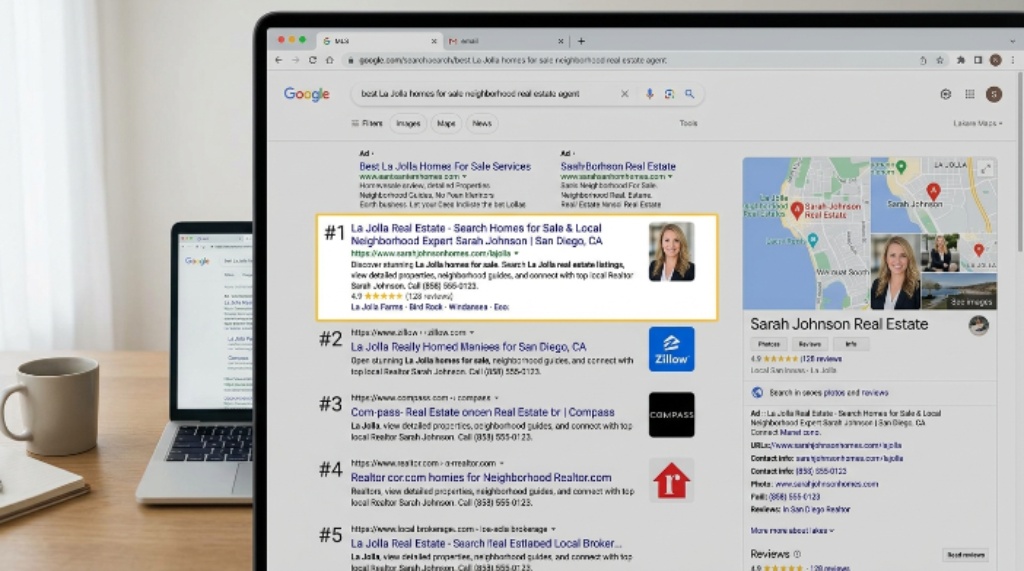
Your Google Business Profile is not just a digital business card. It is one of the most powerful local ranking tools available to any real estate professional, and it costs nothing to use. However, the majority of agents set it up once and never return to it.
Google uses your Business Profile to decide whether to show your name when someone nearby searches for a real estate agent; in fact, you need to fix this one real estate website flaw before spending another dollar on ads, because profiles that are active, complete, and regularly updated rank significantly higher in local map results than those that are stagnant.
Here is what a fully optimized profile looks like:
- A complete business description that includes your city, specialization, and the types of buyers or sellers you serve
- High-quality photos of your headshot, sold properties, and community events you attend
- A specific service area defined by the neighborhoods and zip codes you cover
- At least one new Google Post published every week sharing a market update, new listing, or local tip
- A consistent flow of five-star reviews with personal, detailed responses from you
The review section deserves special attention. Google treats reviews as trust signals. The more reviews you have, and the more recent they are, the higher your profile climbs in local results. Therefore, building a simple follow-up system that asks happy clients for a Google review immediately after closing is one of the highest-return habits you can develop.
Responding to every review matters too. A thoughtful response to a positive review shows Google and potential clients that you are engaged and professional. Even a negative review, handled graciously, can demonstrate character and build trust.
Secret 3: Neighborhood Pages Are Your Most Valuable SEO Asset
A single neighborhood page, done properly, can generate leads for years. Most agents skip this entirely or publish thin, generic content that Google ignores. The opportunity that leaves on the table is enormous.
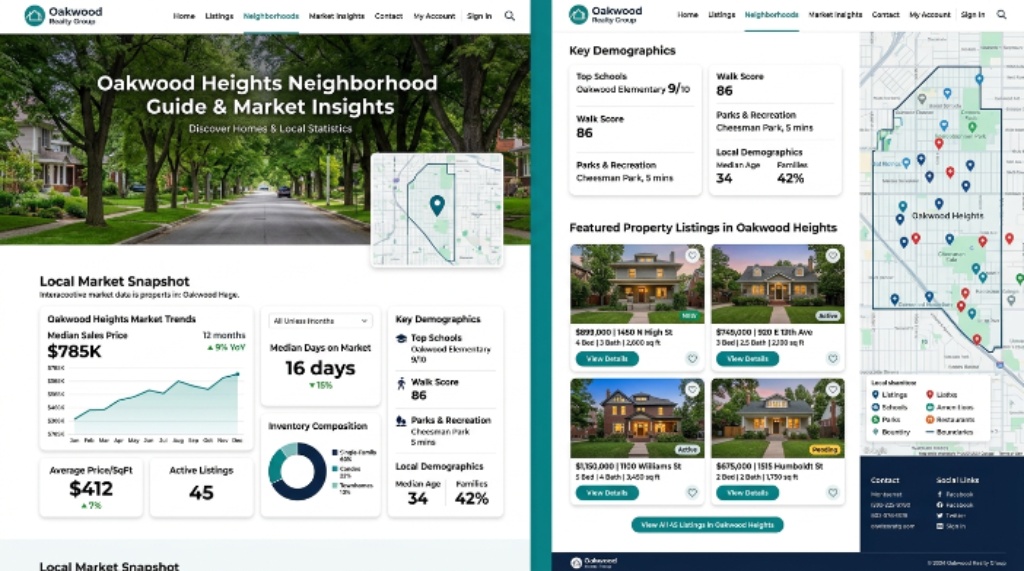
A strong neighborhood page does not just list properties. It answers every question a relocating buyer or curious homeowner might ask about a specific area. Google’s algorithm is designed to surface pages that genuinely help people, and a detailed neighborhood guide does exactly that.
What a high-performing neighborhood page should include:
- A brief, engaging overview of the neighborhood’s character and appeal
- Information about local schools, with links to school rating pages
- Nearby amenities including parks, grocery stores, restaurants, and fitness centers
- Average home prices and recent market trends for that specific area
- Commute times to major employment centers
- Any neighborhood-specific HOA information or zoning details
- A map or visual layout of the neighborhood’s boundaries
- An embedded property search filtered to that neighborhood
Additionally, updating these pages regularly signals to Google that the content is current. A page last updated three years ago will not rank as well as one refreshed each quarter with new market data and sold price averages.
One agent in a mid-size Texas market built 40 neighborhood pages over 18 months. Within two years, those pages generated more inbound leads than any paid advertising campaign she had ever run. The investment was time, not money. That is the power of this approach.
Secret 4: Long-Form Blog Content Builds Authority Faster Than You Think
Many agents post short blog entries of 300 or 400 words and expect results. That length rarely ranks for competitive real estate topics. Google tends to reward longer, more thorough content that comprehensively covers a subject.
A blog post of 1,200 words or more, built around a specific question that buyers or sellers in your market are asking, can attract consistent organic traffic for years after publication. The key is choosing topics that are relevant, local, and genuinely useful.
| Blog Topic Type | Example | Best For |
| Buyer Guides | First-time homebuyer guide for Denver 2026 | Attracting buyer leads |
| Seller Guides | How to price your home in a slow market | Attracting listing appointments |
| Market Updates | Austin housing market report Q3 2026 | Building local authority |
| Neighborhood Deep Dives | Living in Midtown Atlanta: What to Expect | Hyperlocal SEO |
| Process Explainers | How long does escrow take in California | Building trust with searchers |
Each of these post types targets a different stage of the buyer or seller journey. Therefore, a mix of topics across your blog creates multiple entry points into your website for different audiences at different stages of their decision.
Consistency matters more than volume. Publishing one well-researched, well-written post per month outperforms publishing four thin posts per week. Quality signals to Google that your site is worth ranking. Quantity without quality does the opposite.
Additionally, internal linking between your blog posts and your neighborhood pages creates a connected content structure that Google crawls more efficiently. Every time you mention a neighborhood in a blog post, link to your dedicated neighborhood page for it. This builds authority across your site rather than concentrating it in a single place.
Secret 5: Page Speed and Mobile Experience Directly Affect Your Rankings
Most agents focus entirely on content and ignore the technical side of their website. That is a mistake. Google evaluates the technical health of your site before it even considers your content. A slow, poorly designed website will not rank well regardless of how good your writing is.
The majority of real estate searches now happen on mobile devices. Someone driving through a neighborhood they like will pull out their phone and search for homes there within minutes. If your website takes more than three seconds to load on a mobile connection, most of those visitors will leave before reading a single word.
Key technical areas every agent website should address:
- Page load speed below three seconds on mobile, tested using Google’s PageSpeed Insights tool
- Images that are compressed and properly sized rather than uploaded at full camera resolution
- A mobile-responsive design that adjusts cleanly to any screen size without horizontal scrolling
- An SSL certificate, meaning your site uses HTTPS rather than HTTP in the address bar
- No broken links or pages that return errors when clicked
Additionally, your website’s structure plays a role. A clean, logical site structure with clear navigation helps both users and search engines understand what your site is about and find its most important pages quickly.
However, you do not need to be a developer to fix most of these issues. Many website platforms used by real estate agents include built-in performance tools. Additionally, a one-time technical audit from a freelance SEO specialist often costs less than a single month of paid advertising and fixes problems that will benefit your site for years.
The agents who combine strong content with a technically sound website consistently outrank those who focus on only one of the two.
Conclusion
Real estate SEO rewards agents who understand how buyers and sellers actually search and who build their online presence around those real behaviors. Targeting hyperlocal keywords instead of generic phrases puts you in front of motivated searchers with far less competition. A fully optimized Google Business Profile with consistent reviews and activity makes you visible in local map results. Detailed neighborhood pages give Google exactly the kind of helpful, location-specific content it wants to surface. Long-form blog posts build authority over time and attract multiple types of leads across the buyer and seller journey. Finally, a fast, mobile-friendly website ensures that all of your content work actually reaches the people searching for it. Apply these five principles consistently and your website becomes your most productive team member.
Frequently Asked Questions
How long does it take for real estate SEO to show results?
Most agents begin seeing measurable improvements in organic traffic within three to six months of consistent effort. Hyperlocal neighborhood pages and an optimized Google Business Profile tend to produce results faster than broader keyword strategies. SEO is a long-term investment, but the returns compound significantly over time.
Do I need to hire an SEO agency as a real estate agent?
Not necessarily, especially in the beginning. Many of the highest-impact strategies — publishing neighborhood content, updating your Google Business Profile, collecting reviews, and improving page speed — can be handled independently. An agency becomes most valuable once you have the basics in place and want to accelerate results at scale.
What is the most important SEO action a real estate agent can take today?
Start with your Google Business Profile if it is incomplete or inactive. It is free, it directly affects local search visibility, and improvements show results faster than almost any other strategy. Once your profile is optimized, focus on publishing your first detailed neighborhood page.
How many neighborhood pages should I build for my real estate website?
Build one page for every area you actively serve. If you cover 15 neighborhoods, build 15 pages. If you cover a broader region with dozens of subdivisions, create pages for the ones where you have the most expertise and the most listings. Quality matters more than quantity — one exceptional neighborhood page outperforms ten thin ones.
Does blogging actually help real estate agents rank on Google?
Yes, significantly. Blog posts that target specific questions buyers and sellers in your market are asking bring consistent organic traffic over time. Posts on topics like local market updates, buyer guides, and neighborhood deep dives attract visitors at different stages of the real estate journey and build your site’s overall authority with search engines.